
The disulphide bonds of insulin.
Publication Details
Biochem. J., 60, 541-56. 1955 CE.
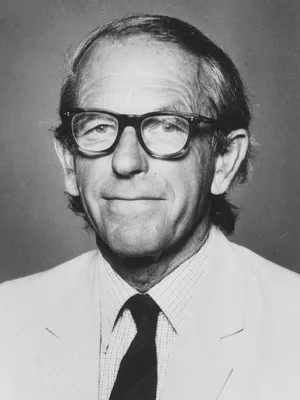
Sanger sequenced the amino acids of insulin, the first of any protein. His work “revealed that a protein has a definite constant, genetically determined sequence—and yet a sequence with no general rule for its assembly. Therefore it had to have a code” (Judson, The Eighth Day of Creation, p. 188). With Andrew Peter Ryle, L. F. Smith and R. Kitai.
In 1958 Sanger received the Nobel Prize in Chemistry "for his work on the structure of proteins, especially that of insulin."
In 1980 Sanger shared half of the Nobel Prize in Chemistry with Walter Gilbert "for their contributions concerning the determination of base sequences in nucleic acides." The other half was awarded to Paul Berg "for his fundamental studies of the biochemistry of nucleic acids, with particular regard to recombinant-DNA."
Thematic Classifications
| Catalog Metadata | Reference Information |
|---|---|
| Entry Number | #1207 |
| Permanent Link | https://staging.historyofmedicine.com/entry/1852 |
| Author Bio Link | Wikipedia ↗ |
| External URL | the-disulphide-bonds-of-insulin |