
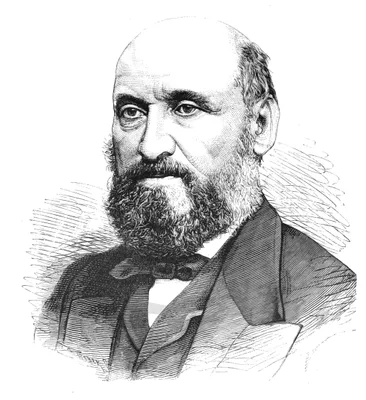
FARR, William (1807 – 1883)
1807 – 1883
6 entries in the GMN corpus.
Image source Unknown author Unknown author · Popular Science Monthly Volume 23 · Public domain
1839 CE
#12127
First annual report of the Registrar-General on births, deaths, and marriages in England.
In 1836 the Births and Deaths Registration Act was passed in England with provisions for inquiry into causes of death in the population, and registration began during the following year through the General Registratio…
1839 CE
#1699
Vital statistics. IN: A statistical account of the British Empire: exhibiting its extent, physical capacities, population, industries, and civil and religious institutions by J[ohn] R[amsey] McCulloch, 2nd ed., 2, 52-90.
Ranks with Graunt’s Observations as an original contribution to medical statistics. Significantly expanded from the first edition (1837). Digital facsimile from Google Books at this link.
1859 CE
#7388
On the construction of life-tables, illustrated by a new life-table of the healthy districts of England.
Preliminary report, describing the use of the Scheutz Engine no. 3, a Babbage-style difference engine, to prepare life tables. The report's table B1, "Life-Table of Healthy English Districts," printed from stereotype …
1864 CE
#1700.1
English life table. Tables of lifetimes, annuities, and premiums.
First extensive application of a mechanical computer to medical statistics. The appendix details the use of the Scheutz version of Charles Babbage’s calculating machine in the construction of English Life Table …
1875 CE
#1703
Supplement to the thirty-fifth annual report of the Registrar-General of Births and Marriages in England.
Includes statistical calculations of the effect on life expectation if certain preventable diseases were eliminated.
1885 CE
#1704
Vital statistics. A memorial volume of selections from the reports and writings of William Farr.
Farr applied statistical methods to epidemiology and was the first mathematically to express the rise and fall of epidemic diseases, thus making possible the more accurate prediction of the occurrence of epidemics.