
Facets
Browse across eight MeSH (opens in new tab) facets — era, geography, science, specialty, technology, history, culture, and reference. Select one tag per group; counts update across the others.
Clear filtersFacet filters
Geography
Specialties & Disease
- Anatomy & Pathology 49
- Cardiology & Blood 10
- Neurology & Psychiatry 26
- Obstetrics & Reproductive 24
- Infectious Disease (General) 8
- Surgery & Anesthesia 67
- Public Health 94
- Immunology & Dermatology 22
- General Clinical Medicine 33
- Military Medicine 38
- Psychology 10
- Alternative & Fringe Medicine 49
- Pediatrics 10
- Ophthalmology & Vision 8
- ENT & Hearing 2
- Urology & Nephrology 8
- Gastroenterology & Hepatology 4
- Pulmonary & Respiratory 3
- Rheumatology, Rehab & Pain 6
- Internal, Emergency & Geriatric 9
- Veterinary Medicine 8
- Epidemiology & Demography 28
- Physiology & Embryology 13
- Dentistry 15
- Plagues & Epidemics 60
- Microbiology & Virology 24
Social & Historical Studies
Institutions & Culture
Reference & Scholarly Works
Drugs & Technology
67 entries match Europe & United Kingdom [Z01.542] · Surgery & Anesthesia [E04 / G02.403.810]
1980 CE
#11454
Professionalizing modern medicine: Paris surgeons and medical science and institutions in the 18th century.
1847 CE
#5656
Recherches pratiques et physiologiques sur l’éthérisation.
Pirogov, the great military surgeon, was with Syme the first in Europe to adopt ether anesthesia, and he left an interesting account of his experiences with it. Digital facsimile from the Hathi Trust at this link.
1567 CE
#9053
Secretos de chirurgia, en especial de la enfermedades de morbo-galico y lamparones, y asimismo la manera como se curan los indos las llgas y heridas, y otras pasiones en las Indias, muy útil y provechoso par España, y otros muchos secretos de chirugia hasta ahora no escritos.
Arias de Benevides travelled to the New World where he observed native remedies and reported them in this book. In the book he also described his performance in Mexico City (1561) of the first neurosurgical interventi…
1927 CE
#6009
Sorani Gynaeciorum libri 4. De signis fracturarum. De fasciis. Vita Hippocratis secundum Soranum. Ed. Johannes Ilberg. Corpus medicorum Graecorum, 4.
Standard Greek edition of the works of Soranus. Digital facsimile from the Corpus Medicorum Graecorum at this link.
1476 CE
#4204
Summa conservationis et curationis. Chirurgia.
![SALICETO, Guglielmo da [WILLIAM OF SALICETO] (1210 – 1277)](/media/portraits/6798)
Contains (Cap. cxl) his classic account of renal edema: De duritie in renibus, an English translation of which is in Major, Classic descriptions of disease, 3rd ed., 1945, p. 527. ISTC no. is00032000.
2001 CE
#13288
Surgeons at war: Medical arrangements for the treatment of the sick and wounded in the British army during the late 18th and 19th centuries.
1907 CE
#5806
Surgical instruments in Greek and Roman times.
Reprinted, N.Y., 1970.
1890 CE
#5798
The annals of the Barber-Surgeons of London, compiled from their records and other sources
Digital facsimile from the Internet Archive at this link.
1971 CE
#8364
The cyrurgie of Guy de Chauliac. I Text (E.E.T.S., 265) Edited by Margaret S. Ogden.
Middle English text of Guy de Chauliac's surgery.
1849 CE
#14
The genuine works of Hippocrates. Translated from the Greek with a preliminary discourse and annotations by Francis Adams. 2 vols.
![HIPPOCRATES, [Ἱπποκράτης; Hippocrates of Kos] (-460 – -370)](/media/portraits/50)
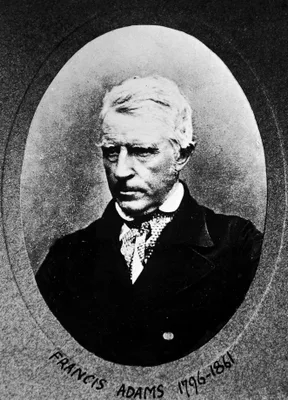
Francis Adams, surgeon of Banchory, Scotland, prepared this partial translation to acquaint his contemporaries with “the opinions of an author, whom I verily believe to be the highest exemplar of professional ex…
1975 CE
#5813.10
The healing hand: Man and wound in the ancient world.
Emphasizing surgery, this is an exceptionally imaginative and exquisitely designed and illustrated history of medicine in ancient Egypt, Greece, Rome, and China.
1963 CE
#8835
The journal of James Yonge, Plymouth surgeon (1647-1721). Edited by F. N. L. Poynter.
A complete account of Yonge's life from the age of ten until the age of 61. "It is considered to be the most important diary of the 17th century after those of Samuel Pepys and John Evelyn.[1] In it Yonge mentioned fa…
1959 CE
#6548.1
The Royal College of Surgeons of England: A history.
1955 CE–1960 CE
#5551.1
The surgery of Theodoric ca. 1267. Translated from the Latin by Eldridge Campbell and James Colton. 2 vols.
Theodoric, a Dominican friar, was a pupil of Hugh of Lucca (circa 1160-1257), whose teachings are reflected in his writings. Allbutt considered Theodoric to be one of the most original surgeons of all time. Borgognoni…
1881 CE
#2176
Ueber primäres Debridement der Schusswunden.
Reyher, a Russian surgeon, reintroduced débridement and made a controlled study of its value in contaminated gunshot wounds during the Russo-Turkish War of 1877. See No. 2177.
2015 CE
#9957
Wounds and wound repair in medieval culture. Edited by Larissa Tracy and Kelly DeVries.
Essays on a wide range of aspects of wounds during the Middle Ages, particularly resulting from war and violence, but also those of Christ, from ca. 1000 CE to the 15th century in the West (England, Ireland, Scotland,…
1682 CE
#8836
Wounds of the brain proved curable, not only by the opinion and experience of many (the best) authors, but the remarkable history of a child four years old cured of two very large depressions, with the loss of a great part of the skull, a portion of the brain also issuing thorough a penetrating wound of the dura and pia mater…
Probably the first monograph in English on surgery of the head and brain. Yonge was a naval surgeon who set up in practice in Plymouth after he gave up the sea. He had just performed the operation for an injury of the…